


Cart
Your shopping cart is empty!
It's never too late to make things right :)


The composition on the bottle answers three practical questions: whether you can use this material on a particular client, whether the product is legally sold in the EU, and whether it will cure in your lamp. So that you always understand the products you work with, this article explains in detail how to read gel polish label information and what to look for first.
INCI is the International Nomenclature of Cosmetic Ingredients. Names are written in Latin script, identically across all EU countries. That is why an INCI list reads the same in Warsaw, Kyiv and Berlin.
The main rule: ingredients are listed in descending order of concentration. The first three or four positions make up the core of the formula. Components below 1% may be listed in any order. Colourants appear at the end under CI codes. The notation '+/-' or 'may contain' indicates a shared pigment list for the entire palette.
In other words, to understand how to decode the label ingredients, start from the top of the list. A substance in second position and a substance in tenth position place a very different load on the skin.
A gel polish ingredient list may look long, but gel polish ingredients fall into four main groups:
Understanding these gel polish components helps you read the full manicure materials composition on any product in your kit.
All acrylates in gel polish and methacrylates cure by the same principle: under light, molecules cross-link into a network.
It is not the finished coating that causes allergy but uncured material on the skin. Small molecules penetrate the skin more easily, so monomers sensitise more often than oligomers. The risk increases in two scenarios: material floods the cuticle area, or a layer is under-cured.
In an under-cured layer, free monomer remains and stays in contact with the plate and the skin for the entire wearing period.
What does HEMA mean exactly? HEMA stands for Hydroxyethyl Methacrylate. It is a small monomer with strong adhesion to keratin. Thanks to this property, the coating holds on the plate without aggressive filing.
The same property makes HEMA a common contact allergen in the nail industry. Since 2021, HEMA and Di-HEMA Trimethylhexyl Dicarbamate have been permitted in nail products in the EU only for professional use. The label must carry two statements: 'For professional use only' and 'Can cause an allergic reaction'.
HEMA in formula is not a violation. It is a signal to work cleanly: thin layers, a gap from the cuticle, full polymerisation. For a client with a confirmed acrylate allergy, such a material should not be offered.
Instead of HEMA, a formula may contain other methacrylates, and cross-reactions between them do occur. That is why allergens in formula should be identified from the full list rather than from a claim on the front label.
If you study gel polish ingredients closely, you have probably already come across the TPO free label. But what is the TPO free meaning, and why have manufacturers started reformulating their products?
TPO (Trimethylbenzoyl Diphenylphosphine Oxide) is a photoinitiator that triggers polymerisation under UV/LED light. It was widely used in gel polishes, particularly in densely pigmented coatings.
The European Union classified TPO as a substance toxic to the reproductive system. From 1 September 2025, its use in cosmetic products within the EU is prohibited. This applies to both the sale of materials and their professional use in salons, regardless of the purchase date.
How to read gel polish label markings to check for this ingredient? Look at the INCI list: TPO in formula may appear under its full name, Trimethylbenzoyl Diphenylphosphine Oxide. If the packaging carries the TPO free label, it means the formula does not contain this photoinitiator.
As a replacement, manufacturers use alternative gel polish components, including photoinitiators such as Ethyl Trimethylbenzoyl Phenylphosphinate (TPO-L) or Hydroxycyclohexyl Phenyl Ketone. They also ensure coating polymerisation but differ in their light-absorption characteristics.
When working with updated formulas, it is important to follow the manufacturer's recommendations for lamp, application thickness and curing time. And to properly assess a manicure materials composition, pay attention not only to the absence of TPO but also to other ingredients, including potential allergens in formula.
Harmful components in manicure fall into two categories. Fully banned: TPO. Restricted: HEMA and Di-HEMA Trimethylhexyl Dicarbamate, which are permitted only in professional products. Equally restricted are the stabilisers Hydroquinone and p-Hydroxyanisole, allowed only for professionals and at concentrations up to 0.02%.
The composition is only part of the labelling. Alongside it, there must be:
If any of these is missing, the product was not prepared for the European market.
CPNP certification confirms a product has been notified on the Cosmetic Products Notification Portal, the European portal for cosmetic product notification. Before entering the EU market, the responsible person must submit information about the product, its composition and labelling.
Notification is one of the conditions for the legal sale of cosmetic products in the EU, including Poland. It also gives authorised bodies and toxicological centres access to product information.
Here is how to check gel polish ingredients before making a purchase. First, find the full INCI list on the bottle, the box or the product page. Read the first four positions: they form the core of the formula. Look for TPO; it should not be on the list. Check for HEMA and cross-reference with your clients' reactions. Make sure the batch number, EU address and warnings are present. Ask the seller about CPNP certification.
What about the 'hypoallergenic' claim? EU legislation has no universal definition of this term, and no gel polish can guarantee a complete absence of allergic reactions. So before you look to hypoallergenic manicure formula buy options, it is worth assessing the actual composition of the product.
A safe composition of materials for manicure is not simply the absence of banned substances. It also means a proper safety assessment, transparent labelling and correct application technique.
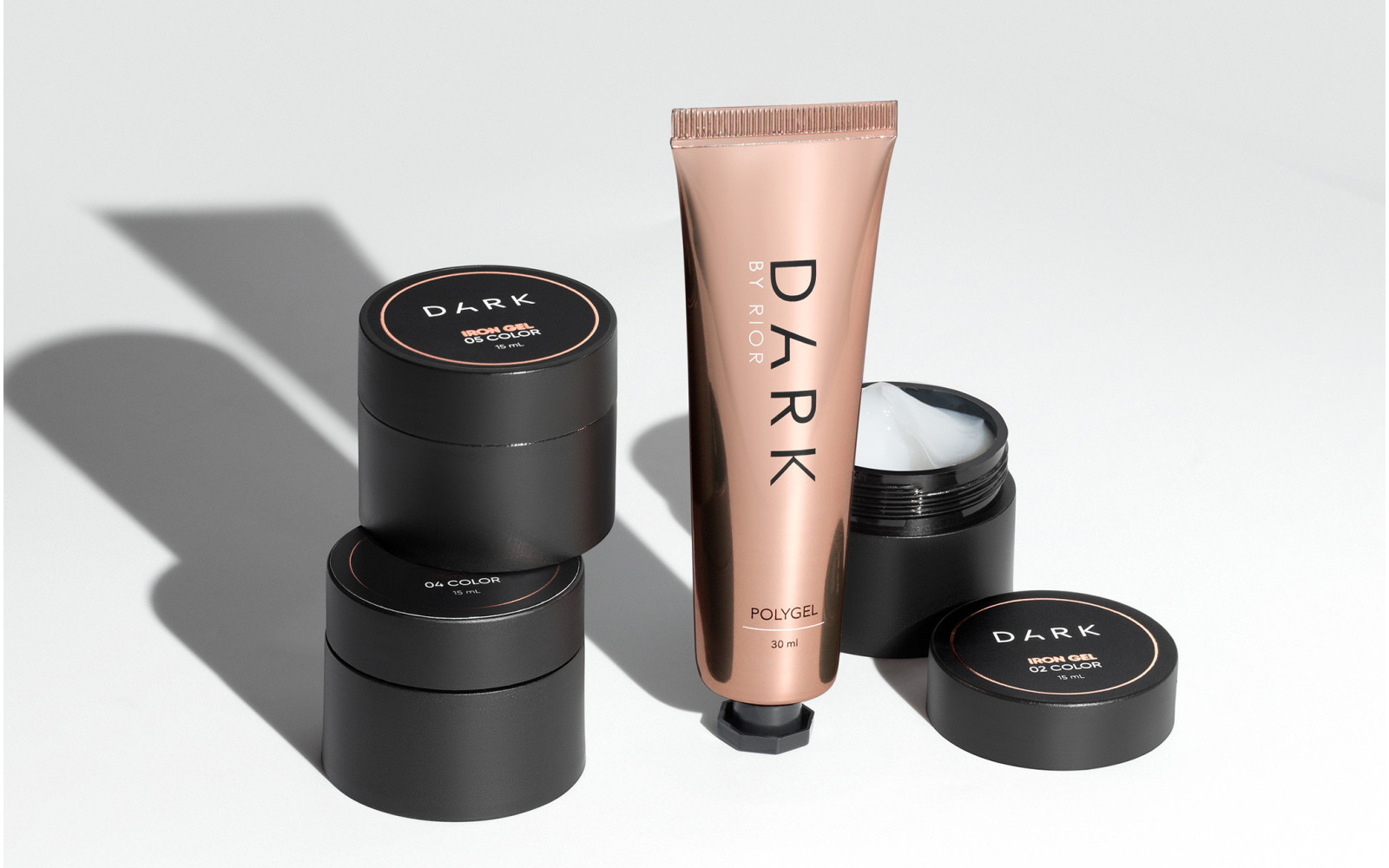
At DARK by Rior, the Dark by Rior composition of every product is published on the product page. There are two separate lines: TPO Free and HEMA Free. All materials released from 1 May 2025 carry the TPO free label.
The full list is printed on the label of every bottle. Products are registered in the CPNP system and intended exclusively for professional use.
You can buy gel polish with safe ingredients on the official website. TPO free materials buy individually or as a set with a base and top coat. Delivery throughout Poland takes 24-48 hours, and orders over 350 zl qualify for free shipping.