


Cart
Your shopping cart is empty!
It's never too late to make things right :)


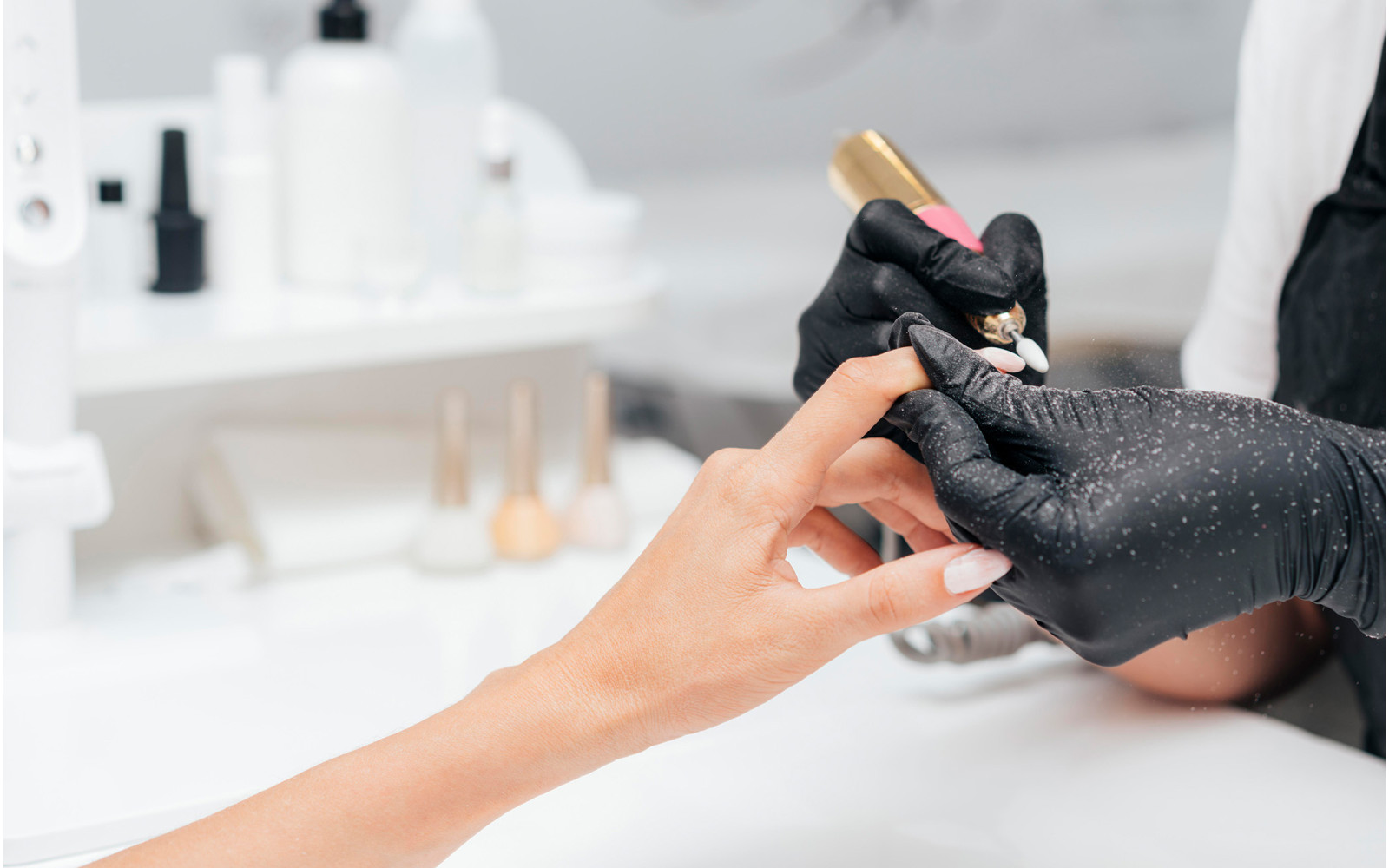
Causes, symptoms and working habits that genuinely affect the risk of contact dermatitis, dust allergy and acrylate reactions.
A technician can work for years with the same gel, base or acrylic gel and then suddenly notice that fingers itch after a shift. That is exactly what makes nail technician allergy so frightening. It does not necessarily appear after the first contact with a material, and it does not always look serious right away. But if the reaction recurs, it already concerns more than comfort at work, because for a technician hands and eyes are literally the primary tools of the trade.
Most often the skin of the hands reacts first. Contact dermatitis nail tech can start with dryness and itching, then progress to redness, cracks or small blisters. The fingers, hands and wrists, the areas most frequently in contact with uncured material, typically suffer the most. If the problem becomes chronic it can develop into occupational hand eczema.
Another risk zone is the eyes and respiratory tract. During removal and infills fine dust forms that the extraction system does not always capture completely. Particles remain airborne, settle on mucous membranes and can trigger sneezing, nasal congestion, throat irritation, tearing or dry eyes. This is how nail dust allergy or respiratory allergy from filing dust can manifest.
At the same time, a single episode of irritation does not yet mean a fully formed allergy. What matters far more is recurrence: if the same symptoms of allergy in nail technician appear regularly during or after a shift, that is reason not to get used to them but to review your protection and pay attention to working conditions.
Gel polish allergy is a rather loose term. The reaction may arise not from the product category as a whole but from a specific component in its formula.
Gel polishes, bases and gels contain acrylates and methacrylates. They matter most in their uncured state, while the material has not undergone full polymerisation and remains reactive.
The causes of acrylate allergy are therefore often linked not only to the product formula but also to how the technician handles it. If uncured material regularly touches the skin, stays on gloves or is wiped off with a finger, the contact repeats again and again.
Monomer allergy develops the same way: through contact with material components before polymerisation is complete.
One of the most widely discussed components in this context is HEMA, or hydroxyethyl methacrylate. HEMA allergy is well known in the nail industry because of the molecule's small size, which allows it to penetrate the skin's protective barrier.
Allergy to manicure materials is often linked to regular skin contact with uncured product, whether from working without gloves or continuing to work in gloves that already have material on them.
Material floods the sidewall and the technician wipes it off and carries on. Gel lands on a glove and changing it over a single tiny drop seems wasteful. Product remains on a finger after sculpting: "I'll finish and then wash my hands."
It is precisely these moments that are dangerous in their ordinariness: when a technician sees several clients a day, minor contact stops being a one-off.
There is a less obvious factor too: open containers. A jar with a wide mouth is exposed to air far longer than a bottle with a brush that is opened only for application. In a poorly ventilated room this adds extra strain on the eyes, nose and throat.
Symptoms of allergy in nail technician are often non-specific, making them easy to disconnect from work.
The most telling criterion is not the severity of a single episode but recurrence.
The shortest answer to how to avoid allergy for nail tech is: do not give the material unnecessary chances to make contact with you.
Of course this does not guarantee that professional manicure allergy will never develop, but reducing regular contact is the foundation of proper nail tech allergy protection and protection from allergy manicure overall.
For working with acrylates it is best to use sturdy nitrile gloves for manicure; latex and vinyl are less reliable for this kind of contact. If uncured gel or base lands on a glove it should be replaced immediately rather than wiped with a tissue: with prolonged contact some monomers can permeate the material.
Equally important is a quality extraction system for nails: it should capture dust at the moment of filing, not after it has scattered across the workspace. Add room ventilation and properly selected respiratory protection, since a standard medical mask does not shield against volatile substances. If eyes regularly redden or dry out, it is also worth checking how well your extraction and ventilation are performing.
It is better not to look for absolutes here. Truly hypoallergenic materials for photo-curable systems is an inaccurate concept. If the formula contains active monomers, a potential reaction remains possible.
TPO is a photoinitiator used in gel systems. DARK BY RIOR works with TPO free formulas: its gel polishes, bases and gels are registered in the CPNP system and comply with EU requirements.
TPO free does not mean allergy-free. The material still needs to be properly cured, kept off the skin and handled in gloves. Formulation can lower risk but does not replace protection. That is the essence of the terms safe Dark formulas and Dark by Rior safe formulas: they refer to specific decisions within the composition, delivering the biggest fear in nail profession a practical, evidence-based response.
The official DARK BY RIOR website offers TPO free gel polishes, bases, builder gels and top coats. Orders are delivered throughout Poland via DHL, with free shipping on orders over 350 zl.
If you are looking to buy hypoallergenic manicure materials, it pays to look beyond the label on the packaging. What matters is the product composition, its purpose and how it is used in practice. Dark by Rior safe formulas are first and foremost TPO free products that meet EU requirements. You can also TPO free products buy and professional anti-allergy products buy in one order on the site.
It is rather a reason to observe a little more carefully how you work throughout the day.
Do you change your glove when base lands on it? Is the extraction system positioned exactly where dust forms? Do you close the jar immediately after use? Does material regularly touch your client's skin or your own hands?
These important details are what protection from allergy manicure is built on.
Take care of yourself as attentively as you take care of your clients' manicures. Take care!