Cart
Your shopping cart is empty!
It's never too late to make things right :)

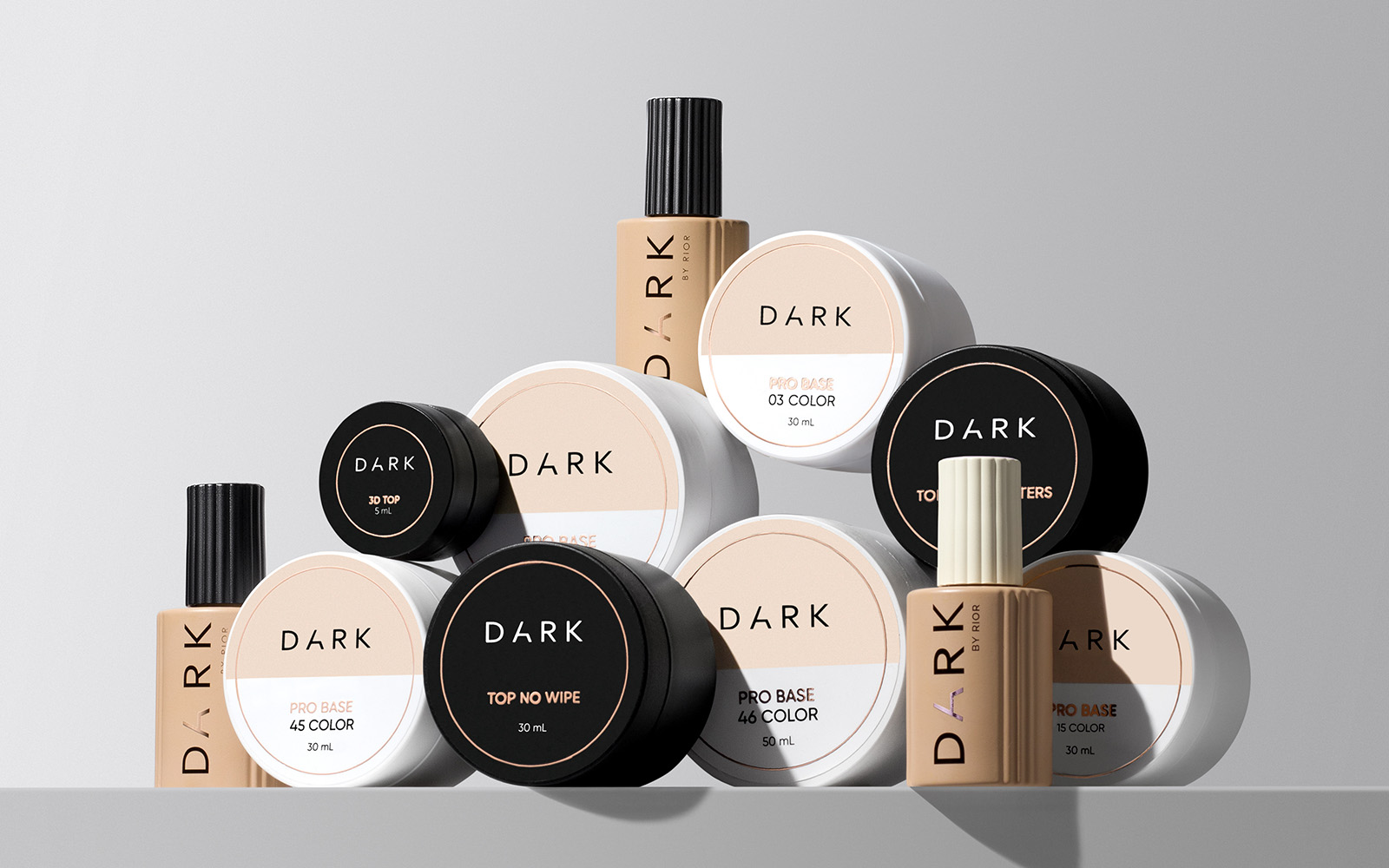
The base is the foundation of the coating. The durability of the manicure, the client's comfort, and the stability of the result depend directly on its properties. Even high-quality gels and gel polishes will not provide the expected effect if the base is chosen incorrectly. In practice, most problems with lifting, cracking, or unstable color are related not to the material in general, but to using the base for the wrong purpose. Therefore, when working with the DARK system, it is important to understand what function each base performs and what tasks it is intended for.
Iconic Base — a universal base with a consistency closer to liquid, allowing for light, thin leveling without excess volume. It has good adhesion and elasticity, does not turn yellow, does not show significant shrinkage, and does not cause a strong burning sensation during polymerization. The base is compatible with all DARK color gels and tops, and can also be used as a substrate (base coat) for gels, polygels, and low-acid systems. It saves time — during light leveling, it can be applied directly in a thin layer on the natural nail without a separate substrate.
Scotch Base — a base exclusively for use as a substrate. It has a thicker consistency. The main function of this base is to enhance adhesion between the natural nail and subsequent materials. It is not intended for leveling or building architecture, as it may not fully polymerize when applied in a thick layer, which reduces the stability of the coating and increases the risk of lifting. Therefore, Scotch Base is always used in a thin layer under any bases, gels, or polygels, especially on problem nails.
Clear Base (ProClear) — a low-acid base with a liquid consistency, designed for architectural leveling and creating a "naked" nail effect on short lengths. It is flexible and does not crack even on thin nails; however, due to its plasticity, it is not suitable for strengthening the nail plate. In most cases, Clear Base is applied after a substrate of Scotch Base or Iconic Base. On an undamaged nail plate, it can also be used without a medium-acid base, provided an ultrabond has been applied beforehand.
.jpg)
| Name | рН | Consistency | Purpose |
|---|---|---|---|
| Scotch Base | pH 4 (medium-acid) | Thicker | For substrate. Leveling is prohibited. |
| Iconic Base | pH 4 (medium-acid) | Medium | For thin leveling. Compatible with all materials. |
| Clear Base | Around рН 6 (low-acid) | Liquid | For architectural leveling and a "naked" nail effect on short lengths. |
The correct choice of base for a specific task allows you to build the coating properly, reduce the risk of errors, and ensure a stable result in wear.

-800x500.jpg)